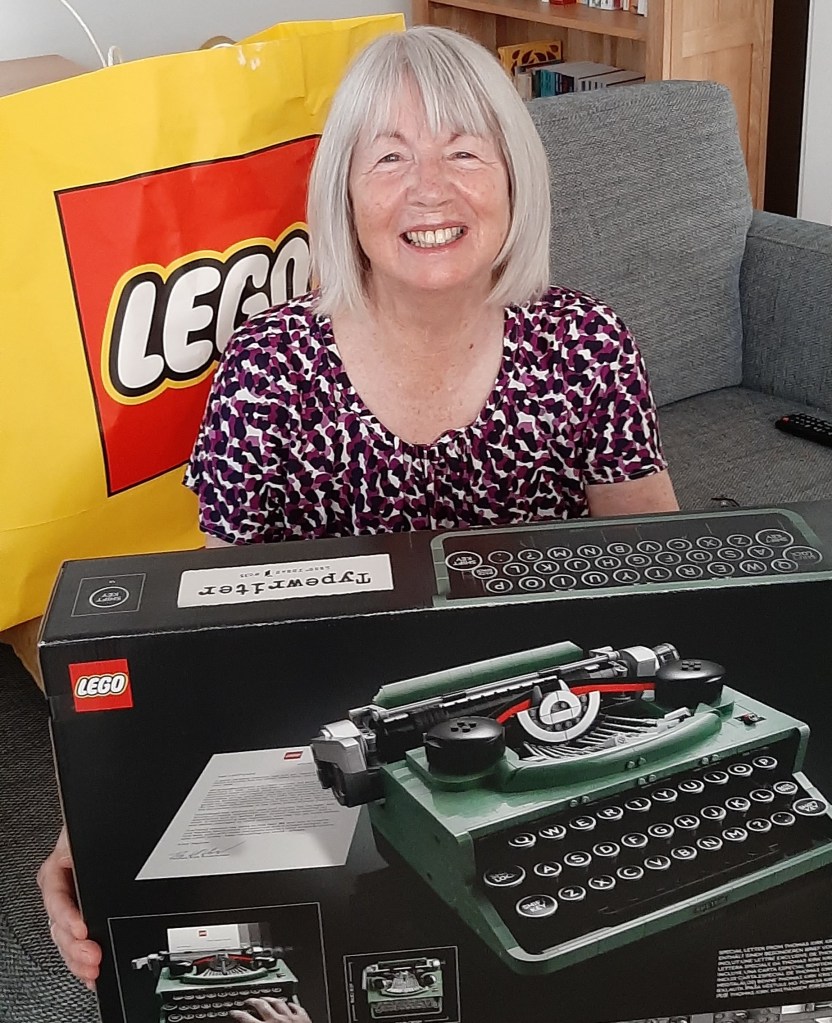
Look what I got for my birthday! I had seen this vintage Lego typewriter in the shop window and said to Charlie that I would love to buy it. I then forgot all about it so you can imagine my delight when he presented me with a huge Lego bag on my birthday. It has 11 packets of pieces so I think it will probably take me a year to put it all together given that I have never really done much Lego building. However, this blog isn’t about Lego, it’s about typewriters. Seeing that typewriter brought back loads of memories so I thought I would share them with you.
The first time I saw a typewriter, I was about seven. My mum was an office cleaner and sometimes she would take me to the office with her in the evening. My memories from those times were the gleaming brass nameplates, doorbells and letterboxed which my mum polished up with Brasso and lots of elbow grease. While she cleaned, I sat at one of the desks playing with a typewriter and imagining myself as a typist. When I went to secondary school, I was delighted when one of our subjects was shorthand and typing. I remember we had a male teacher, Mr McKenzie I think his name was, which was unusual in those days, and all us girls had a real crush on him and were keen to impress him with our new-found skills.
When I left school in 1965 and found a job as an office junior, I went to night school to improve my prowess at shorthand and typing. By the end of my studies and the award of several RSA Certificates, I was able to type at 90 wpm and take shorthand at 130 wpm. I remember Charlie and I went to see a French film a couple of years ago about a girl who competed in the world championship for the fastest typist (based on a true story) and I think if I had known about it I might have tried to enter. Of course, speed wasn’t everything. Accuracy was important too. When doing the RSA tests we got 10 points I think it was deducted for every mistake.
When I started work, one of the first things I was taught was how to take care of the typewriter and its cover. There was a special method of folding and storing the cover and it was used to make sure no dust got in. In those days we also had to change the ribbon and type things in duplicate using carbon paper. It was a real bummer if you made a mistake, as you had to use an eraser to rub out your mistake not only on your top copy but all the duplicates as well. Trying to avoid getting your fingers covered in ink was a nightmare as you were likely to leave smudges all over the paper and would need to start again from scratch. Later there was Tippex fluid and when electric typewriters were invented, they had a special white ribbon. That was unless you worked in a solicitors’ office, which I did. We weren’t allowed to make any mistakes when typing legal documents such as Wills, Title Deeds etc and the boss would hold the document up to the light to make sure we hadn’t rubbed anything out as it would have made the document invalid.
As time progressed so did the typewriter. I remember my first experience with an electronic typewriter was around 1976. I can’t remember how it worked now, but it allowed the typist to type up a standard document which was then transferred somehow onto a magnetic belt. The text and margins were standardised and all the typist had to do was fill in the blanks and then run it off. I think this was the forerunner of the word processor. Remember them? I wasn’t lucky enough to have one of them and when I did my dissertation back in the late eighties, it was written on an old Remington that I had at home. By the time I became Director of a housing association in 1991 computers were made available to all staff and instead of dictating or writing out my letters and documents for my secretary to type up, I could type everything up myself in draft and she could produce the final documents in half the time.
Being able to touch type (i.e. without looking at the keys) has been of tremendous value to me in my student life, working life, and now in my retirement as a creative writer. Who would have thought way back when I dreamed while my mother cleaned, that the typewriter would have become such a wonderful and useful part of my life.
Anyone else have typewriter memories? I’d love to hear them.
 MARION MACDONALD